







JPEG XS TDC cuts the bandwidth of a video stream substantially, while keeping what made JPEG XS successful: visually lossless quality, sub-frame latency and lightweight implementation.
Since its first edition, JPEG XS has been the reference codec for transporting high-quality video over IP, SDI and wireless links. It earned that place by working below the frame level: it codes each frame independently, line by line, buffering only a few lines instead of whole frames. That choice keeps latency to a few lines, a fraction of a millisecond, and makes every frame independent, but it also means the codec ignores one of the richest sources of redundancy in video: what stays the same from one frame to the next.
The Temporal Differential Coding (TDC) extension, invented by intoPIX and standardized in the 3rd edition of JPEG XS, answers a simple question: can JPEG XS exploit that redundancy without becoming a heavy, high-latency, GOP-based codec? This article explains how it works, what it brings, and where it makes the most difference.
Key takeaways
- Up to 50% less bandwidth on screen, graphics and gaming content, versus JPEG XS High, bringing high-quality 4K60 to standard 1GbE networks.
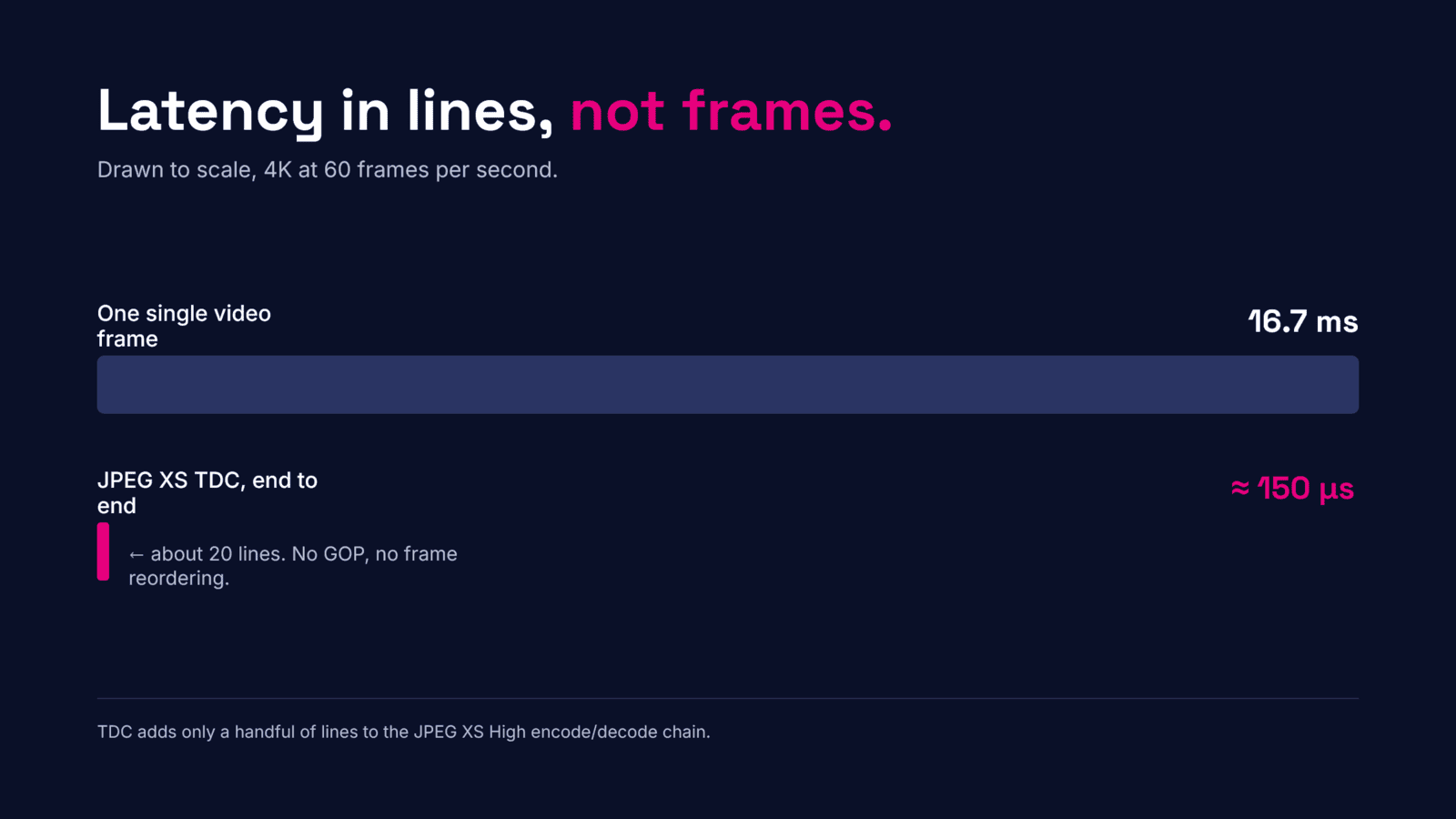
- Latency still measured in lines: around 20 lines, about 150 µs in 4K60, versus 16.7 ms for a single frame. No GOP, no motion search.
- Still lightweight: one small, compressed frame buffer, on embedded memory or reduced external DDR.
What TDC enables in practice - powered by intoPIX TicoXS FIP
TicoXS FIP is the intoPIX implementation of JPEG XS High and TDC, available as IP cores for FPGA and ASIC and as an SDK for CPU and GPU. With it, you get:
4K60 over standard GigE
Visually lossless to lossless
Backward interoperable
Ready on every platform
A quick recap: how JPEG XS works without TDC
JPEG XS is both an image and a video codec: the same coding system compresses a single still image or a continuous video stream. Until the 3rd edition, every JPEG XS profile (Light, Main, High, and the RAW profiles) was purely intra-frame. Each frame is transformed with a lightweight wavelet, quantized and entropy-coded line by line, with no reference to any other frame.
This design delivers the properties the market values:
- Latency of a few lines, not frames, end to end.
- Constant (and predictable) bit rate, which suits IP networks, SDI mapping and wireless links.
- Very low complexity, running on CPU, GPU, FPGA and ASIC, with only small internal memories in hardware.
- Visually lossless quality, robust over multiple encode/decode generations.
What TDC is: intoPIX’s temporal prediction for JPEG XS
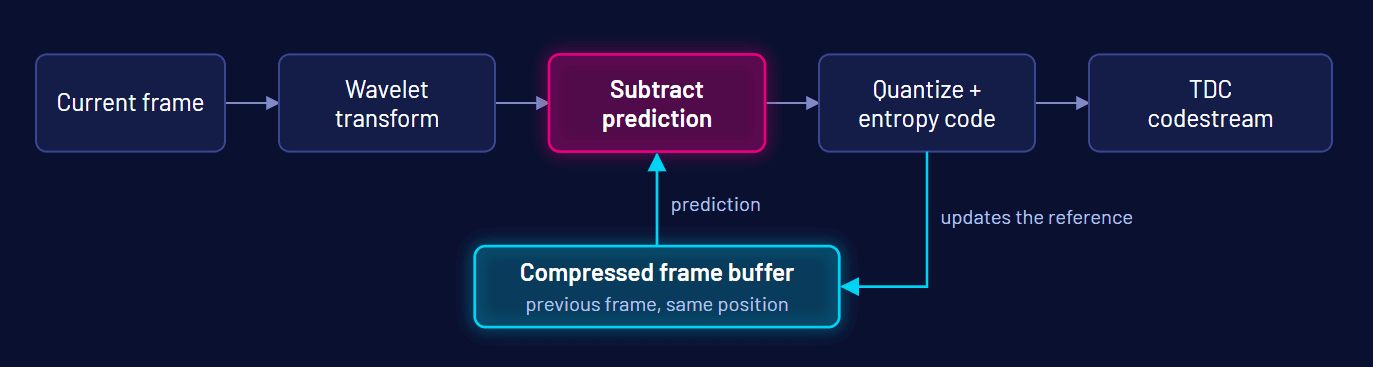
TDC adds one block to the JPEG XS High pipeline: a temporal prediction step in the wavelet domain, fed by a single frame buffer, as shown in the diagram at the top of this article.
- The current frame is wavelet-transformed, exactly as in XS High.
- Instead of coding the wavelet coefficients directly, the encoder can code the difference with the co-located coefficients of the previous frame, held in the frame buffer.
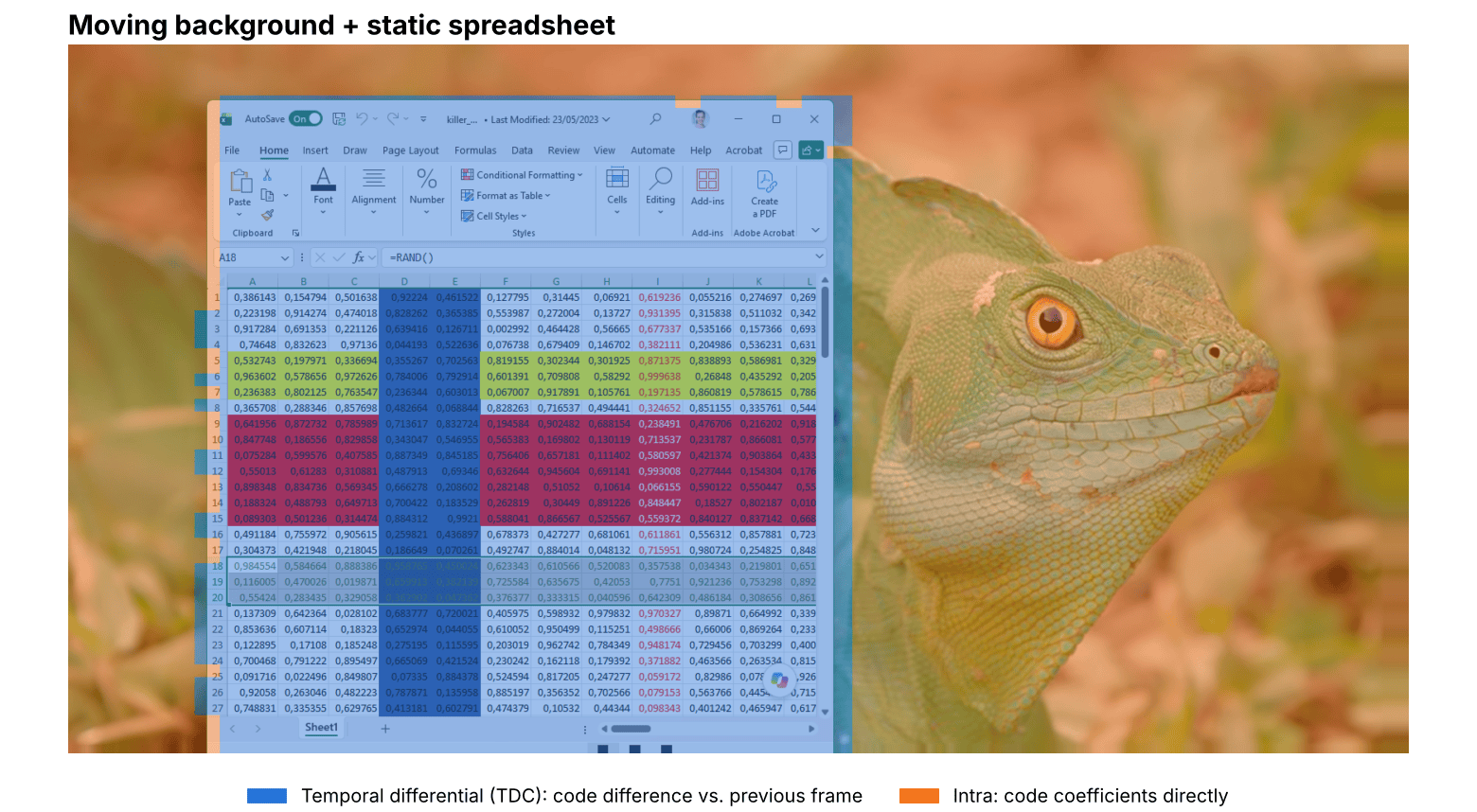
- Where the image has not changed, that difference is close to zero and costs very few bits. Where it has changed, the codec simply codes the coefficients as XS High would.
- The decoder keeps the same frame buffer and adds the difference back.
Four design choices keep TDC faithful to the JPEG XS philosophy:
- Prediction in the wavelet domain. This is what makes TDC unique. Conventional inter-frame codecs predict pixels before the transform. TDC predicts after it, directly on wavelet coefficients, so it reuses the XS High pipeline as is and keeps its line-based, low-latency behavior.
- No motion estimation or compensation. The prediction is deterministic and in place: same position, previous frame. This removes the heaviest part of classic inter-frame codecs.
- A single, compressed frame buffer. The reference is stored in compressed form, which keeps memory size and memory bandwidth under control. It is far smaller than the multiple full-resolution reference frames that MPEG-type codecs such as H.264/AVC and HEVC keep for motion-compensated prediction. This is what lets TDC keep the JPEG XS promise of a lightweight, low-power codec. The standard caps the frame buffer bandwidth through a dedicated “FBB level” parameter, alongside profile, level and sublevel.
- Slice-level choice. The codestream marks slices that use temporal prediction with a dedicated marker (SLI) next to the classic intra slice marker (SLH), so encoders keep fine control over where prediction is used.
What TDC brings
TDC gives you either the same quality at a lower bit rate, or better quality at the same bit rate, with the latency and simplicity of JPEG XS intact.
- Major bandwidth savings on static and semi-static content. For screen content, gaming and eSports, the gain is in the order of 50% versus XS High, as stated by the JPEG XS patent pool. That can mean two streams where there was one, or 4K over a link sized for HD.
- Better quality on difficult content. Graphics, text and desktop captures are where intra codecs struggle most at low bit rates. TDC concentrates bits where things change, which keeps sharp edges and small fonts clean.
- Up to lossless on still content. On mixed content, such as scientific imaging or video combined with static graphics, TDC keeps moving areas visually lossless to near-lossless. Static areas go further: thanks to temporal prediction, they can reach mathematically lossless quality at the same bit rate.
- No penalty on high motion. On fast-changing content, TDC naturally falls back to XS High performance. It never does worse than the profile it builds on.
- Latency stays in lines, not frames. Temporal prediction adds only a handful of lines to the encode/decode chain, so the total stays around 20 lines. There is no GOP, no B-frame and no reordering.
- Still lightweight, on every platform. TDC targets CPU, GPU, FPGA and ASIC like every other JPEG XS profile. In hardware, the compressed frame buffer can stay internal.
- A safe upgrade path. The TDC profile includes XS High, so a TDC device can decode both TDC and XS High streams.
What to keep in mind
TDC is not free, and a good article should say so. The main costs are modest but real.
- Memory. TDC needs a frame buffer, where XS High needs only a few lines of internal memory. Because TDC embeds its own frame buffer compression, that buffer stays small: it can run on embedded memory, or use only a reduced amount of external DDR. It still deserves a line in the memory budget of FPGA and ASIC designs. Interlaced video uses one buffer per field.
- Memory bandwidth. Reading and writing the reference costs bandwidth. The FBB level parameter exists precisely to bound it, so implementers know what to provision.
- Dependency between frames. A frame now depends on the previous one, so packet loss can propagate until the affected area is refreshed. Network design, FEC or redundancy (such as ST 2022-7) and the encoder’s refresh strategy matter more than with intra-only streams. The impact is much lower than with MPEG-type codecs, though: every TDC frame mixes intra- and inter-coded content, so there is no long chain of predicted frames hanging on a single key frame, and quality recovers quickly. Similarly, a receiver joining a multicast group can quickly reconstruct a complete frame as areas are progressively refreshed, without having to wait for a single key frame.
- Gains depend on content. The bigger savings come from static or semi-static images. For constantly moving camera content, expect XS High results, not more.
Where TDC makes the biggest difference
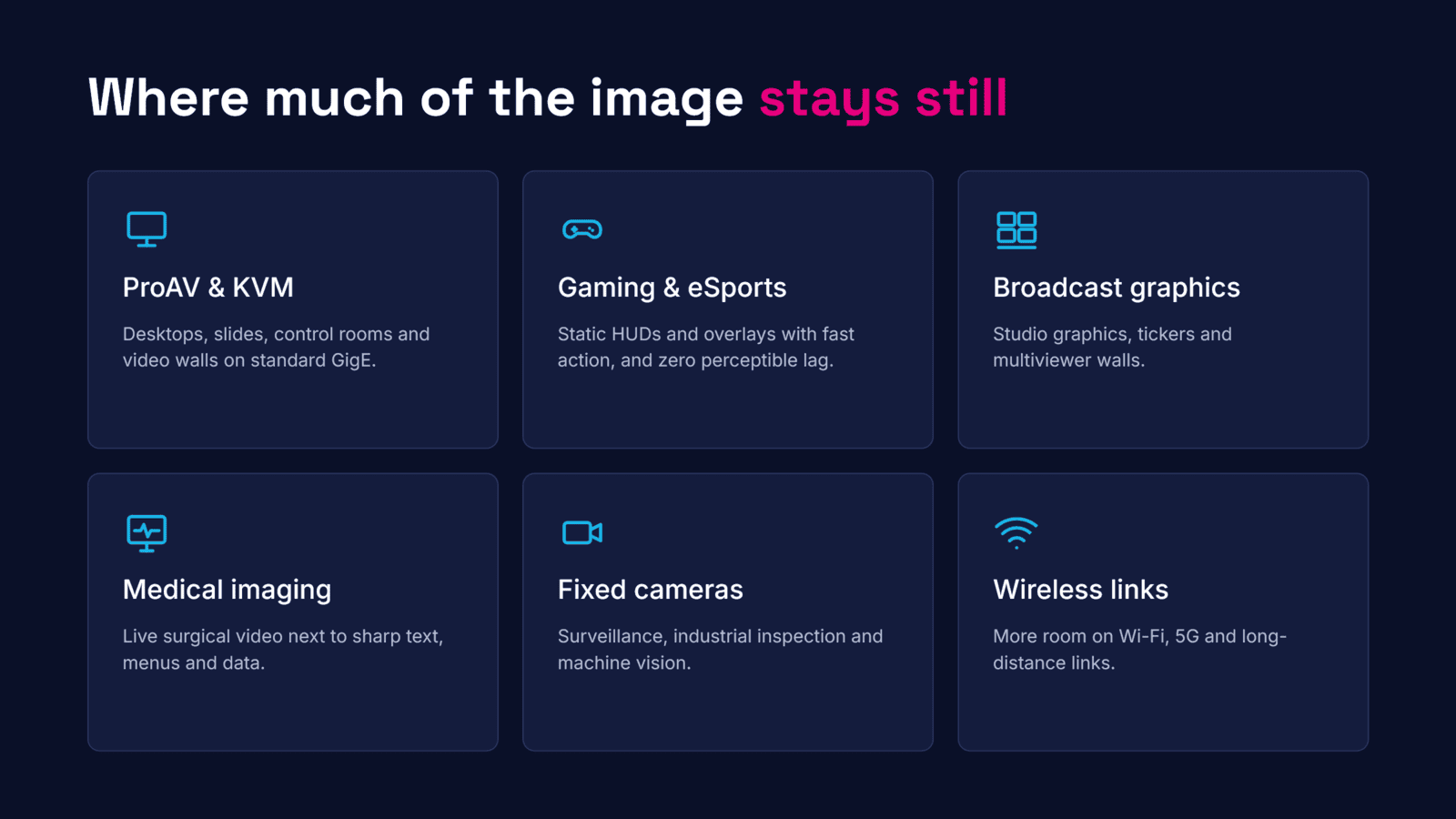
TDC shines wherever much of the image stays still and latency must stay invisible.
- ProAV and KVM. Computer desktops, presentations, control rooms and video walls are mostly static. TDC fits more of them on standard GigE infrastructure.
- Gaming and eSports. Game feeds combine static HUDs and overlays with motion, and they demand zero perceptible lag.
- Broadcast graphics and multiviewers. Studio graphics, tickers and monitoring walls gain quality at the same bit rate.
- Medical imaging. Surgical and diagnostic displays mix live video with static UI and data, where text sharpness and latency both matter.
- Fixed-camera applications. Surveillance, industrial inspection and machine vision often film static scenes, where TDC saves bandwidth and storage.
- Wireless and constrained links. Halving the bit rate on suitable content opens room on Wi-Fi, 5G or long-distance links.
Where the standards stand
TDC is part of the published standard, and the ecosystem to support it is already in place
| BODY | DOCUMENT | WHAT IT COVERS FOR TDC |
|---|---|---|
| ISO/IEC JTC 1/SC 29 (JPEG) | ISO/IEC 21122, 3rd edition (2024–2025) | Defines the TDC coding mode, the TDC profiles and the FBB level |
| IETF avtcore | draft-ietf-avtcore-rtp-jpegxs-3ed | Revises RFC 9134 so RTP and SDP can carry and signal TDC streams |
| AIMS / IPMX | IPMX JPEG XS TDC Profile Mode v1.0 | Optional TDC mode on top of the baseline IPMX JPEG XS profile |
| VSF | TR-07 / TR-08 revisions | New TDC capability sets (AT, BT, CT, ET) for transport over MPEG-2 TS and ST 2110-22 |
| Vectis patent pool | Pool license extension (April 2025) | TDC profiles added to the license at no extra royalty |
Conclusion: more efficiency, same JPEG XS DNA
TDC brings JPEG XS the one thing intra-only coding could not offer: the ability to stop paying, frame after frame, for pixels that have not changed. It does so without motion search, without GOPs and without giving up latency measured in lines.
For static and screen-heavy content, that means up to half the bandwidth. For everything else, it means XS High quality, guaranteed.
Evaluate TDC on your own content
intoPIX co-created JPEG XS, invented TDC and holds several patents essential to it, so commercial TDC implementations require a license. Our TicoXS FIP IP cores and SDK, as well as the Titanium FPGA SoC and Titanium SDK, implement TDC on top of XS High, so your products stay interoperable with the installed base of JPEG XS High equipment.
Further reading
Technical papers
- JPEG XS as the Mezzanine Format for Mixed File- and IP-Based Production Workflows, NAB BEIT Conference Proceedings, April 2026. Lossless transcoding from JPEG XS High CBR to TDC VBR for storage, saving up to 43% versus JPEG XS High CBR and XAVC at the same visual quality.
- JPEG XS 3rd Edition: The New Temporal Differential Coding (TDC) Profile, SMPTE Motion Imaging Journal, September 2025. The reference paper on how TDC works, with PSNR gains above 10 dB on graphics, eSports, gaming and desktop content.
- The New JPEG XS TDC Profile: Perfect Quality at Zero Latency, SMPTE Media Technology Summit, October 2024. The first public presentation of TDC.
- intoPIX papers and application notes, including the TDC white paper and JPEG XS fundamentals.
Standards and transport
- RTP Payload Format for JPEG XS (draft-ietf-avtcore-rtp-jpegxs-3ed), the IETF revision of RFC 9134 for TDC streams.
- IPMX JPEG XS TDC Profile Mode v1.0, sender and receiver requirements for ProAV over IP.
- VSF TR-07 and TR-08 revision update, October 2025.
Related content

Titanium FPGA SoC EDKIPMX and ST 2110 endpoints on FPGA SoC, with JPEG XS FIP/TDC.
Titanium FPGA SoC EDKIPMX and ST 2110 endpoints on FPGA SoC, with JPEG XS FIP/TDC.

Titanium SDKIPMX and ST 2110 in software on COTS servers and PCs, with JPEG XS FIP/TDC.