







A newly published UHD World Association standard writes JPEG XS directly into its 8K programme-file requirements — a concrete signal of where large-scale UHD broadcasting is heading.

China's UHD World Association (UWA) has published a new technical standard — T/UWA 012.1-2023 — defining the video, audio, and file-packaging requirements for the "Bai Cheng Qian Ping" ("a hundred cities, a thousand screens") initiative: an ambitious public broadcasting project delivering 8K UHD HDR video and 3D audio to large public screens across more than a hundred Chinese cities. Buried in its technical tables is a detail worth highlighting for anyone working in broadcast infrastructure: for 8K UHD programme files, the standard mandates JPEG XS (ISO/IEC 21122-2), High 444 12 Profile, wrapped in MXF OP1a.
Why this matters
The standard draws a clear line between its 4K and 8K requirements. For 4K UHD content, it specifies XAVC-I — an older conventional intra-frame broadcast codec. But once resolution steps up to 8K (7680×4320), the requirement shifts to the more recent JPEG XS , at a specified intra-frame bitrate of roughly 2073.6 Mbps, still packaged inside the same MXF OP1a container that the rest of the workflow already uses.
| 4K UHD | 8K UHD |
| 3840 x 2160 | 7680 x 4320 |
| XAVC-I | JPEG XS High.444.12 |
| >500 Mbps | 2073 Mbps Intra-frame |
- Visually lossless, so mezzanine-quality material can move through multiple encode/decode generations — capture, editing, storage, distribution to hundreds of display sites — without the cumulative artifacts of lossy inter-frame compression.
- Low-latency and low-complexity, since it's intra-only (every frame coded independently), which matters for a system feeding live 8K signals to large-screen networks in near real time.
- A clean fit for existing file-based and IP workflows, since MXF wrapping (OP1a, KLV-encoded, per SMPTE ST 377-2, ST 378M, and ST 379-2) is already the backbone of professional broadcast file exchange — JPEG XS sits naturally inside the same container tools already used for 4K. JPEG XS is the standard for live IP production used in ST 2110, VSF TR07, IPMX, etc...
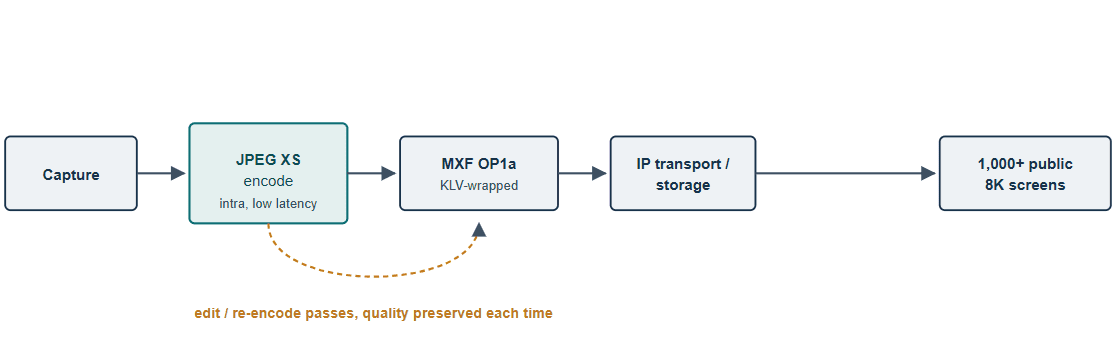
For an initiative broadcasting to public screens at this scale, quality retention across a heavy production pipeline, manageable file sizes at 8K, and drop-in compatibility with the MXF/KLV tooling the industry already relies on are exactly why a standards body would choose JPEG XS over a more conventional, higher-compression codec.
How JPEG XS sits inside the MXF file
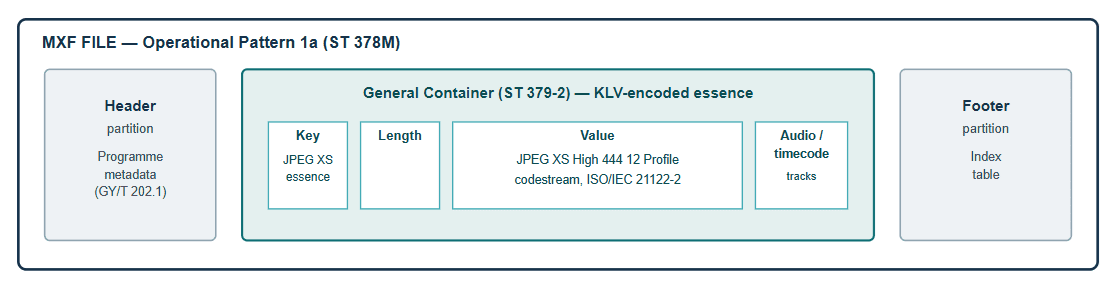
The standard is specific about the wrapping, not just the codec: files must comply with SMPTE ST 377-2 (file format), ST 379-2 (constrained general container), and ST 378M (Operational Pattern 1a — single item, single package), with KLV (Key-Length-Value) data encoding throughout. In practice, that means the JPEG XS elementary stream becomes just another essence track inside a standard MXF OP1a structure — the same structural pattern already used for 4K XAVC-I files in the same workflow.
A signal of broader adoption
T/UWA 012.1-2023 is a concrete example of JPEG XS being written directly into a national broadcasting standard's file-format requirements for large-scale UHD delivery—not just used ad hoc, but formally specified alongside SMPTE MXF standards as the codec of record for 8K programme exchange. It's a useful data point for broadcasters and system integrators evaluating codecs for next-generation UHD file-based workflows, and it reinforces JPEG XS's role as a mezzanine/production codec for content that has to survive many hops between capture and screen without visible quality loss.
The full standard (T/UWA 012.1-2023, English translation) is available from the UHD World Association.
Source: UHD World Association, T/UWA 012.1-2023 — Technical requirements of programme broadcasting of UHD video and audio broadcasting system for "Bai Cheng Qian Ping."
Related content
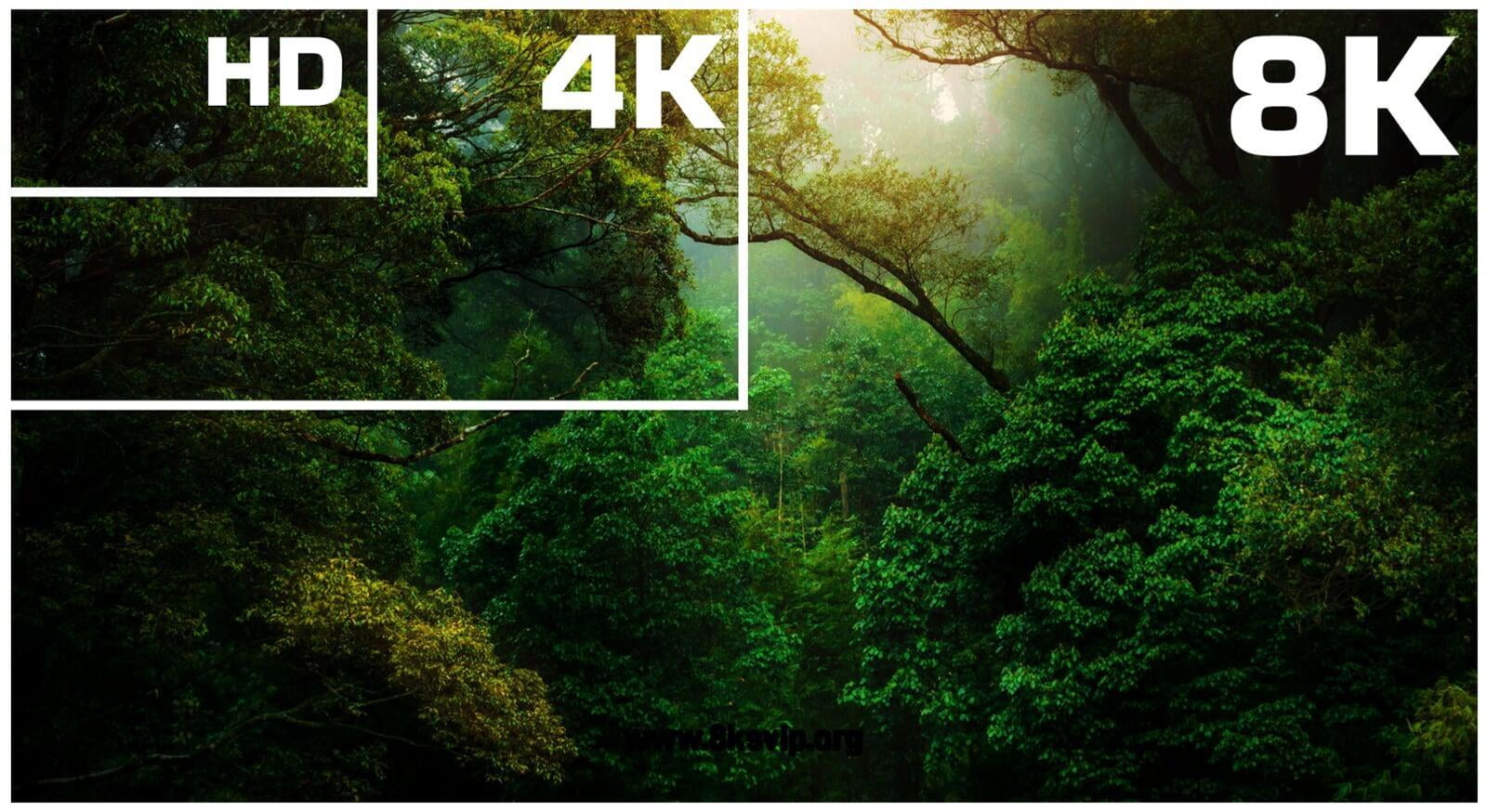
Discover our 8K Solutions, 8K AVoIP transport, 8K low latency compression, 8K mezzanine compression, 8K RAW compression, ...We are expert in 8K
Discover our 8K Solutions, 8K AVoIP transport, 8K low latency compression, 8K mezzanine compression, 8K RAW compression, ...We are expert in 8K

intoPIX JPEG XS, the new lightweight low-latency ISO standard is design to replace uncompressed video, preserving a microsecond latency, a lossless quality with a minimal encoding/decoding complexity, which perfectly answer the needs of the automotive industry.
intoPIX JPEG XS, the new lightweight low-latency ISO standard is design to replace uncompressed video, preserving a microsecond latency, a lossless quality with a minimal encoding/decoding complexity, which perfectly answer the needs of the automotive industry.