







If you are building a professional video product that streams over IP, you have probably encountered both IPMX and SMPTE ST 2110. They sound similar, they share a large amount of technology, and they often appear together in the same sentence. So what exactly is each one, how do they relate, and which one should your product support?
What is SMPTE ST 2110?
SMPTE ST 2110 is a family of standards developed by the Society of Motion Picture and Television Engineers for transporting professional media — video, audio, and ancillary data — over IP networks in broadcast environments.
Its key standards are:
- ST 2110-20— uncompressed video
- ST 2110-22 — compressed video (including JPEG XS)
- ST 2110-30 — audio (AES67-compatible)
- ST 2110-40 — ancillary data and metadata
- ST 2110-21 — traffic shaping (Narrow and Wide sender profiles)
ST 2110 is built on RTP over UDP/IP, uses SDP (Session Description Protocol) to describe streams, and relies on PTP (IEEE 1588 / SMPTE ST 2059) for precise timing synchronisation across devices. NMOS (Networked Media Open Specifications) from AMWA is widely used alongside ST 2110 for stream discovery and connection management, though it is not formally part of the standard itself.
What is IPMX?
IPMX (Internet Protocol for Media Experience) is an open standard developed by the Video Services Forum (VSF) and promoted by the AIMS Alliance. It is designed specifically for the ProAV industry — AV-over-IP in corporate, education, live events, and installation environments.
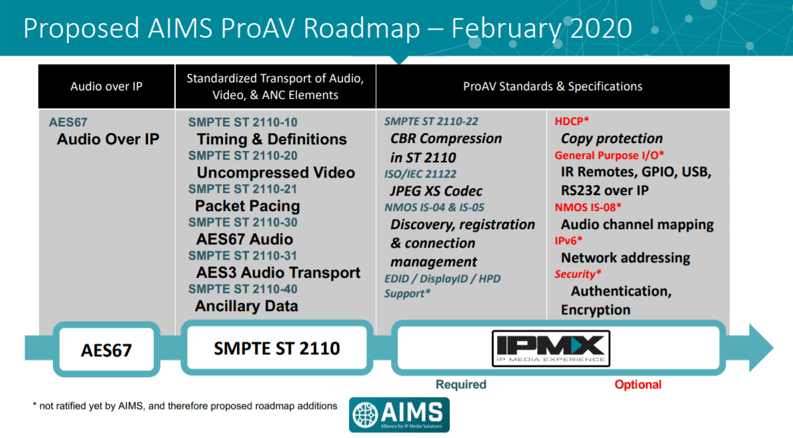
IPMX is not a competing standard to ST 2110. It is built on top of ST 2110, extending it with features the ProAV market needs:
- NMOS IS-04/05/09/11 — mandatory (not optional) for plug-and-play discovery and connection management
- Non-PTP timing— RTCP-based system timing for networks without PTP infrastructure, which is common outside broadcast
- PEP / HKEP encryption — Privacy Encryption Protocol (VSF TR-10-13) for content protection, equivalent to HDCP in the IP world
- HDMI and DisplayPort compatibility — IPMX defines gateway interoperability so standard AV sources connect seamlessly
- JPEG XS — mandatory compressed video format (VSF TR-10-2), enabling 4K at 4:4:4 over a single 1 GbE link
The full IPMX specification is published as VSF TR-10 (Technical Recommendations 10-1 through 10-13), covering timing, video, audio, ancillary data, security, and more.
How do they relate?
Think of it this way:
| Feature | SMPTE ST 2110 | IPMX (VSF TR-10) |
|---|---|---|
| Target market | Broadcast & live production | ProAV — corporate, education, events |
| Transport | RTP / UDP / IP | RTP / UDP / IP (same) |
| Video compression | JPEG XS (ST 2110-22) | JPEG XS mandatory (VSF TR-10-2) |
| Timing | PTP IEEE 1588 required | PTP optional — RTCP non-PTP supported |
| NMOS | Recommended | Mandatory (IS-04, IS-05, IS-09, IS-11) |
| Encryption | Not defined | PEP / HKEP (VSF TR-10-13) |
| HDMI / DP gateway | Not addressed | Defined |
| ST 2110 compatible | — | Yes — IPMX senders are ST 2110 compliant |
Which should your product support?
Studios, live production & contribution links
Corporate AV, education & live events
One design, two markets — build for IPMX
The third path — building for IPMX to address both markets — is exactly what theintoPIX Titanium FPGA SoC EDK and Titanium SDK enable: one integration, one codebase, both standards covered. enable: one integration, one codebase, both standards covered.
What about devices outside broadcast and pro AV?
IPMX and ST 2110 are not limited to traditional AV markets. The underlying transport — RTP over UDP/IP — is the same protocol used by VoIP, video conferencing, and general-purpose media streaming. When coupled with the low-latency JPEG XS compression, any developer who needs ultra-low-latency video over a standard IP network benefits from the same technology stack:
Medical imaging in Operating Room
Machine vision & industrial cameras
Robotics & teleoperation
Defence & ISR
intoPIX and JPEG XS: the compression layer for both standards
Both IPMX and ST 2110-22 mandate or strongly recommend JPEG XS as the compression format for video. JPEG XS (ISO/IEC 21122) is a wavelet-based, visually lossless codec designed specifically for low-latency professional video.

JPEG XS's unique wavelet scalability means receivers can independently decode the full 4K frame, an embedded HD layer, or a specific crop region — all from the same compressed stream. A secondary PROXY stream at qHD (960×540, ~50 Mbps) can be transmitted simultaneously alongside the 4K MAIN stream, both over a single 1 GbE link, independently selectable by receivers via NMOS.
intoPIX develops both TicoXS (JPEG XS High profile) and TicoXS FIP (JPEG XS Flawless Imaging Profile, including TDC mode) — the two codec variants required for full IPMX and ST 2110-22 compliance.
Read the VSF TR08 : Technical Recommendation for JPEG XS over SMPTE 2110-22 & IPMX.
This recommendation includes both information regarding IPMX Timing & IPMX Capability Set information using JPEG XS .
- IPMX JPEG XS Video Senders shall conform to type W in SMPTE ST 2110-21, while Receivers shall implement the timing model defined in VSF TR-10-1.
- IPMX Capability Sets and Interoperability Points are also defined to support amongst other parameters : 4:4:4, 4K, 8K, HDR, etc.
IPMX interoperability testing & intoPIX solutions
Interoperability testing ensures that an intoPIX-based senders and receivers can connect to any IPMX-certified receivers and senders, and vice versa — regardless of manufacturer.
“IPMX addresses the ProAV industry’s need for a single set of common, ubiquitous standards-based protocols that ensure interoperability for AV over IP” said David Chiappini, chair of the AIMS ProAV Working Group. “As the ProAV world increasingly moves toward IP networking, an understanding of IPMX and enabling standards and specifications is essential"
Learn more
- Titanium FPGA SoC EDK — ST 2110 & IPMX for AMD Zynq Ultrascale+
- Titanium SDK — ST 2110 & IPMX for x86-64 Windows & Linux
- JPEG XS — the compression standard behind IPMX
- VSF TR-10 — full IPMX specification
- AIMS Alliance — the IPMX industry body
- IPMX website
- IPMX Training : The Official IPMX Training Series is available online, providing a free educational program designed to help the Pro AV industry understand, design, configure, and deploy IPMX-based AV-over-IP systems.
Learn more
Questions about which standard fits your project?
Related content
Product: TicoXS and TicoXS FIP FPGA
JPEG XS compression IP cores for HD & 4K at the speed of light!

ProAV over IP Solutions
Read more about intoPIX-powered Pro-AV Solutions